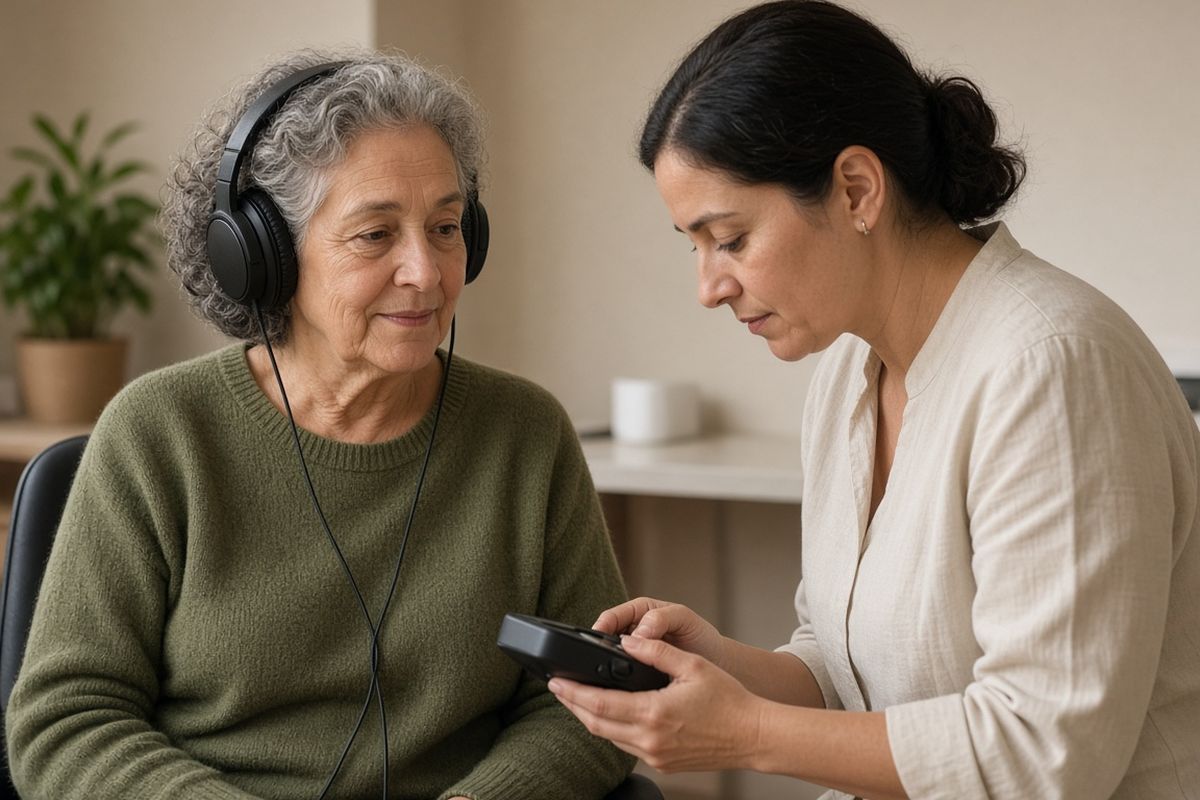
If you have started asking people to repeat themselves, or if a busy restaurant leaves you exhausted, it can feel like a memory problem. Sometimes it is hearing. The two are more connected than most people think, and it is worth getting a clear answer instead of guessing.
Hearing loss is one of the Lancet Commission's list of dementia risk factors that can be worked on. That does not mean hearing trouble will lead to dementia, and it does not mean a hearing aid will prevent it. It does mean hearing care belongs on a brain-health checklist, right beside blood pressure and cholesterol.
The most careful evidence we have so far comes from ACHIEVE, a large NIH-funded trial of hearing care in adults aged 70 to 84. The results are hopeful in one group and honestly disappointing in another. Both parts of the story matter.
Key Takeaways
- Hearing loss is a recognized, modifiable dementia risk factor, but treating it is not a proven way to prevent dementia.
- ACHIEVE tested hearing aids plus counseling in adults aged 70 to 84, compared with a health-education program.
- For the full study group, there was no difference in cognitive decline over three years.
- In a smaller, higher-risk group (older adults already in a heart-health study), hearing care was associated with about 48% slower decline in thinking and memory over three years.
- In healthier community volunteers, there was no effect on cognitive decline within three years. Researchers are still following participants.
- A hearing check is a reasonable next step if conversations have gotten harder, or if "brain fog" might actually be missed words.
What ACHIEVE Set Out to Learn
The ACHIEVE study asked whether a hearing intervention, hearing aids plus counseling, could slow the loss of thinking and memory abilities compared with a successful-aging health education program.
Participants came from two different groups. One group, 238 people, was already taking part in a heart-health study. On average, they were older and had more risk factors for cognitive decline. The other group, 739 people, was made up of healthy volunteers newly recruited from the community.
That split turned out to be the key to understanding the results.
What the Trial Found, and What It Did Not
When researchers looked at everyone together, the hearing intervention was not better than the health-education program at slowing declines in thinking and memory over three years. That is the main, overall result, and it should be said clearly.
When they looked at the two groups separately, the picture changed:
- In the heart-health study group, the higher-risk group, the hearing intervention reduced cognitive change by 48% over three years.
- In the newly recruited healthy volunteer group, the hearing intervention had no effect on reducing cognitive decline within three years.
Investigators believe the benefit showed up in the heart-health group in part because that group declined about 2.7 times faster during the study. When thinking and memory change slowly, as they did in the healthier volunteers, it is harder to see whether hearing care makes a further difference in only three years. The team is still following participants to look at longer-term effects on cognition and other outcomes, including brain health, mood, physical function, and health care use.
The National Institute on Aging summarized the high-risk finding in its coverage of the trial. The study's own key-findings page is the source for the 48% figure, the overall null result, and the two-group split.
How to Read a "48%" Result Without Overpromising
A 48% slower decline in a higher-risk subgroup is a meaningful research finding. It is not the same as "hearing aids protect memory" or "hearing aids prevent dementia." It applies to a specific group in a three-year trial. It does not tell you what will happen for you.
Even so, there is a practical takeaway that does not depend on overreading the statistics. If you are missing parts of conversations, your brain is working harder just to keep up. That extra effort can feel like fog or fatigue. Getting your hearing checked does not require you to decide anything in advance about hearing aids. It simply gives you information.
This fits the spirit of Basecamp 1 in the PEAK program, which is about foundations and observation: know your baselines before you try to change them. You can see how that stage works on The Program page. ACHIEVE is also noted on the Evidence page.
A Simple Next Step
If you are 30 or older and hearing has not been checked in a long time, or if a partner has started to mention the television volume, ask your clinician about a hearing test. If you already know you have hearing loss and have been putting off treatment, this trial is a reason to reopen the conversation, especially if you have other risk factors for cognitive decline.
None of this replaces medical advice. Hearing care should be planned with a qualified clinician who knows your health history.
Your Next Move
Noticing a change, and getting it checked, is a form of brain care. If you want a physician-led look at hearing alongside other risk factors, start with the PEAK consultation information and The Program.
Dementia is not your destiny. The climb begins now.
This article is for educational purposes and is not a substitute for personal medical advice. Talk with your physician or an audiologist about hearing concerns.
Sources
- Lin FR, Pike JR, Albert MS, et al. Hearing intervention versus health education control to reduce cognitive decline in older adults with hearing loss in the USA (ACHIEVE): a multicentre, randomised controlled trial. The Lancet. 2023;402(10404):786-797. doi: 10.1016/S0140-6736(23)01406-X. Full text: PMC10529382
- National Institute on Aging, "Hearing aids slow cognitive decline in people at high risk": https://www.nia.nih.gov/news/hearing-aids-slow-cognitive-decline-people-high-risk
- ACHIEVE Study, key findings: https://achievestudy.org/key-findings